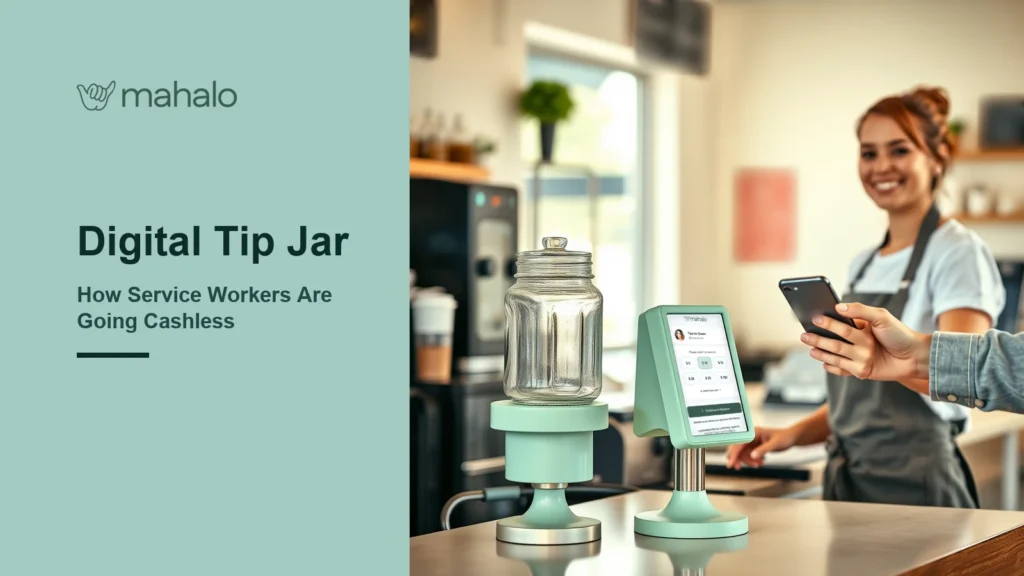
Most customers in a Vancouver café, salon or restaurant still want to leave a tip. What has changed is how few of them carry anything to leave it with. For the people whose income depends on those tips, choosing a tipping app has stopped being a nice-to-have and become a question of take-home pay.
This guide sets out what a tipping app actually needs to do for Vancouver’s service industry, which features matter, and how to judge the options without getting lost in marketing claims.
Key takeaways
- The best tipping app is the one that turns a customer’s intention to tip into money in the worker’s account, in seconds, with no cash involved.
- Contactless is now the default way Canadians pay: Payments Canada reports that contactless made up 58% of transactions in 2024.
- Tap-to-pay removes steps that QR-code tipping adds, and every extra step is a chance for a tip to be abandoned.
- Tips are employment income in Canada, so a tipping app that keeps a clear record of what you received saves work at tax time.
- Individual and gig workers need a tipping app that works without a point-of-sale terminal.
Why Vancouver’s service workers need a tipping app

The shift away from cash is not just a feeling; it shows up in national payment data. According to Payments Canada’s Canadian Payment Methods and Trends report, contactless payments accounted for 58% of all transactions in 2024, while cash made up just 11% of payment volume. Mobile contactless payments alone grew 28% in a year, to 3.4 billion transactions.
For a server with a card terminal, that shift is mostly handled by the tip prompt on the machine. For everyone else, it is a problem. A hairstylist renting a chair, a valet, a food-truck operator, a delivery driver, a busker or a hotel housekeeper often has no terminal at all. When a customer says “sorry, I don’t have any cash on me”, that tip is simply gone.
Vancouver sharpens the issue. The city’s hospitality, events and tourism economy relies heavily on tipped roles, and many visitors arrive with cards and phones rather than Canadian cash. A tipping app gives those workers a way to accept the tip the customer already wanted to give.
What a tipping app actually has to do
It is easy to confuse a tipping app with tools that sit next to tipping. A tip calculator tells a customer how much to leave. Tip-pooling software divides tips among staff after the fact. Neither of those moves money from the customer to the worker in the moment.
A genuine tipping app has one core job: let a customer hand over a tip as easily as they would once have handed over a coin, and get that money to the worker. Everything else is secondary. If you want the step-by-step version from the customer’s side, the easy way to tip on your phone walks through it.
Five features that separate a good tipping app from a weak one
When service workers compare tipping apps, the same five features decide whether the tool helps them or quietly costs them money.
| Feature | Why it matters | What to check |
|---|---|---|
| Speed at the moment of tipping | Tips are impulse decisions, and friction kills them | How many steps from “I’d like to tip” to done |
| No terminal required | Many tipped workers have no point-of-sale machine | Can an individual accept a tip without business hardware |
| Fast payouts | Tips often cover day-to-day costs | How long until the money reaches your account |
| Clear, stated fees | Hidden percentages erode tip income | Is the fee shown plainly before you sign up |
| A usable record | Tips are taxable and need tracking | Can you see and export what you received |
Speed at the moment of tipping. A customer deciding to tip has a few seconds of goodwill. A tipping app that works with a single tap fits inside that window; one that needs typing and scanning often does not.
No terminal required. This is the dividing line for gig and independent workers. An app built for individuals lets the worker receive a tip directly, without a business account or card reader.
Fast payouts. A tip that takes a week to arrive is far less useful to someone paying rent. Look for payout timing that is stated clearly; instant tip transfer explains why speed matters so much to tipped workers.
Clear, stated fees. Every tipping app has costs. The useful question is whether the fee is visible and predictable, so you know exactly what share of each tip you keep.
A usable record. Because tips count as income, a clean history of what you received is worth more than any flashy feature.
Tap-to-pay versus QR codes for tips
Many tipping apps rely on QR codes: the customer opens their camera, scans, waits for a page to load, then enters an amount and payment details. It works, but every step is a point where a willing tipper can give up, especially in a busy line or a dim bar.
Tap-to-pay tipping uses the same NFC contactless technology people already use at the checkout. The customer taps a card or phone and the tip is done. Beyond speed, NFC also avoids some of the risks that come with codes posted in public places, which we cover in more depth in why NFC payments are safer than QR codes for public use.
Tips, taxes and record-keeping in Canada
A tipping app is also a record-keeping tool, whether or not it is marketed as one. The Canada Revenue Agency is clear that tips are considered employment income for income tax purposes.
CRA separates two kinds of tips. Controlled tips are collected or controlled by the employer and then paid out to staff, so the employer withholds and reports them. Direct tips are paid by the customer straight to the worker, and the employer has no control over the amount; the employer does not include those on the T4. That is exactly why workers who receive tips directly benefit from a tipping app that keeps a clear history of every amount received.
Workplace rules matter too. In Ontario, for example, the Employment Standards Act generally stops employers from withholding or deducting from employees’ tips, except where tips are collected and redistributed among employees. If you work in a pooled-tip environment, check how your workplace handles distribution before assuming a personal tipping app changes it.
Choosing a tipping app by role
The right tipping app depends on how you work.
Servers and bartenders. If your workplace has card terminals, most table tips are already covered. A personal tipping app helps with the gaps: bar-top tips, cash-light customers, and events where terminals are scarce.
Hairstylists, barbers and estheticians. Chair renters and independent operators often take payment for the service one way and have no easy route for the tip. A tipping app that works without a terminal fills that gap directly.
Delivery drivers, valets and couriers. These roles involve short, in-person moments at a doorstep or a car door. One tap is the only realistic interaction.
Event, hotel and hospitality staff. Housekeepers, porters and event crews are among the most cash-dependent tipped workers. For the hotel side of this, see cashless tipping for hotels.
How Mahalo approaches tipping
Mahalo was built in Vancouver around the problem this guide describes: tipped workers losing income because customers no longer carry cash. The approach is deliberately simple. A customer taps a card or phone to leave a tip, with no QR code to scan and no app for the customer to download, and the money reaches the worker quickly with a clearly stated fee.
It is designed for individuals as well as businesses, which matters for the many tipped workers in Vancouver who have no point-of-sale terminal of their own. If you are setting this up for the first time, how to accept tips without cash covers the practical steps.
Whatever tipping app you choose, the test stays the same: when a customer wants to tip you, can they do it in a single, familiar motion?
Frequently asked questions
What is the best app for tipping?
The best app for tipping is the one that makes the moment of tipping effortless for the customer and gets the money to the worker quickly, with fees stated clearly. For service workers without a card terminal, that usually means a tap-to-pay tipping app built for individuals, rather than one that relies on QR codes or bank transfers.
What is the best tip distribution software in Canada?
Tip distribution software solves a different problem from a tipping app: it divides pooled tips among staff after they have been collected. If your workplace pools tips, make sure the process follows provincial employment standards; in Ontario, employers may only withhold tips in order to redistribute them among employees. A tipping app handles the earlier step of receiving the tip in the first place.
What is the best free tip tracking app?
A dedicated tracker can help, but the simplest record is the one created automatically when tips arrive through a tipping app. Because the Canada Revenue Agency treats tips as employment income, and direct tips are not included on your T4 by your employer, keeping a complete record of what you receive is worth doing whichever tool you use.
Is 10% tip disrespectful?
Not inherently. Tipping in Canada is discretionary, and expectations vary by service, region and the customer’s own background, which is why international visitors often feel unsure what to leave. What does make a difference is how easy tipping is: customers are more likely to tip at all when they can do it with one tap.